
08
Legal safeguards for children and applicants with special needs
Both prior to their displacement but also during their journey, applicants for international protection may be subjected to abuse, exploitation and violence. Among them, numerous women, girls and boys have experienced extreme forms of violence, including sexual violence. To increase protection responses, the Pact on Migration and Asylum includes measures for swifter identification and fast follow-up for vulnerabilities and special procedural and reception needs.
In 2024, national authorities highlighted their commitment to meet these new requirements, but they also indicated that this area was one of the most challenging. Civil society organisations assessed that a major issue is the lack of sufficient resources for swift identification, age assessments, legal guardians and follow-up services, such as mental healthcare. As the pressure continued on asylum and reception authorities, there was reduced capacity to provide adequate follow-up for physical and mental health issues, including trauma.
The EU’s revised Anti-Trafficking Directive was adopted in May 2024, expanding its scope to include forced marriage, illegal adoption and the exploitation of surrogacy as crimes. The directive also obliges Member States to implement more rigorous tools to investigate and prosecute new forms of exploitation and provide a higher level of support services to victims of trafficking. Several EU+ countries drafted or updated their national anti-trafficking action plans based on the new rules. Stakeholders observed with concern the rapidly-evolving and growing use of new technologies for trafficking and exploitation and underlined the need for harmonised data collection to better understand the phenomenon and prepare more adequate counter-measures.
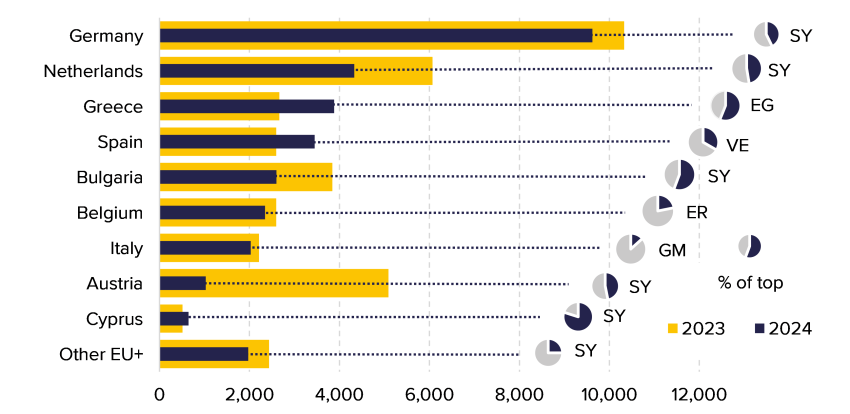
In 2024, 32,000 asylum applications were lodged by self-claimed unaccompanied minors, approximately 16% less than in 2023. Although experiencing a slight decline, Germany received 9,600 applications and continued to be the top receiving country, accounting for 30% of the total (see Figure 3). Greece (3,900 applications) received an unprecedented number of applications by unaccompanied minors, with an increase of 46%. Almost one-half of unaccompanied minor applicants in EU+ countries were either Syrians (10,000 applications) or Afghans (4,500). Record numbers of applications were lodged by unaccompanied minors from Egypt (2,900 applications, almost all of them in Greece and Bulgaria), Ukraine and Peru.
In 2024, the majority of efforts in the area of supporting applicants with vulnerabilities focused on minors, especially unaccompanied minors, with measures to ensure adequate accommodation, care and treatment and initiatives to finetune age assessments in several countries. A worrying phenomenon continued at times with the detention of children in EU+ countries, as documented in court judgments (including at the level of the ECtHR) and reports from international and civil society organisations. Focus was also placed on the protection of women, with judicial authorities having a strong role in establishing standards and guiding practices (for example the CJEU landmark judgments C-621/21, C-646/21 and C‑608/22 and C‑609/22), and national authorities introducing initiatives to strengthen safeguards for victims of sexual violence and female genital mutilation/cutting.
Figure 3. Top EU+ countries receiving applications by self-claimed unaccompanied minors, 2024 compared to 2023 and share of applications lodged by the main citizenship of unaccompanied minors, 2024
Source: EUAA EPS data as of 3 February 2025