

4.1.3. Examining the admissibility of an application and applying special procedures and safe country concepts

Courts played a key role in shaping practices related to safe country concepts and subsequent applications in 2024, which is expected to impact how countries can implement new requirements in the APR. Only a few legislative and policy changes took place in 2024, for example in Bulgaria and Iceland, but as countries begin to align national legislation to the new EU rules, this is expected to change.
In recent years, several EU+ countries have highlighted the challenges of secondary movements of recognised beneficiaries of international protection. In related court cases, the CJEU clarified that when an application from a beneficiary in another Member State cannot be rejected as inadmissible, the asylum authorities must carry out a new examination. They are not bound by the decision of the authority of another Member State, but they must take it into account during the new examination.152
Various EU+ countries received a high or increased number of subsequent applications, and the CJEU delivered two rulings in this context. One confirmed that a judgment from the court may constitute a new element which justifies a full re-examination of the application if it significantly adds to the likelihood of an applicant qualifying for international protection.153 The other judgment highlighted that EU law does not allow the presumption that circumstances created by the applicant after leaving the country of origin (such as religious conversion) stem from abusive intent, and thus, subsequent applications must be assessed on an individual basis.154 The rulings underline the obligations of national authorities and highlight that a thorough examination must take precedence over short-cuts for efficiency gains.
The new APR applies safe country of origin concepts in a broader manner and several analyses have highlighted grey areas in interpretation.155 Still interpreting provisions of the recast APD, the CJEU ruled that a country cannot be designated as a safe country of origin when certain regions do not fulfil the criteria for that designation.156 This led to an update in legislation and practices for example in Italy and the Netherlands (see Figure 4). In addition, the Tribunal of Naples concluded that the CJEU’s argumentation also applied to Egypt.157 The case was invoked by the Tribunal of Rome when deliberating on transfers under the protocol between the Italian and Albanian governments (see Section 3).158
Figure 4.Overview of changes to lists of safe countries, 2024
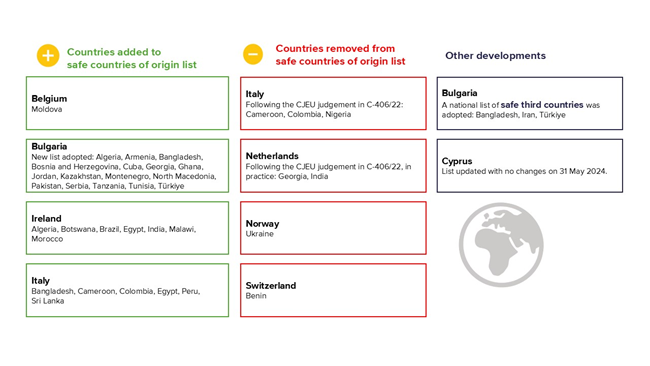
Sources: Bulgaria,159 Belgium, 160 Cyprus, 161 Greece, 162 Ireland, 163 Italy, 164Netherlands, 165 Norway,166 and Switzerland. 167
Nonetheless, ambiguities continued when applying the safe county of origin lists. A question for a preliminary ruling was pending in front of the CJEU on whether a country can be designated as safe with the exception of certain risk profiles,168 and another follow-up question to C-406/22 was referred to the CJEU by the Tribunal of Bologna, seeking clarification about not applying national legislation when there is a conflict between the conditions for designation and EU law.169 At the national level, the Court of Cassation in Italy ruled on the ministry’s authority to set out a list of safe countries of origin and on the adjudicating authority's duty to investigate the safety of countries included in the list and disapply the designation if it conflicts with EU or national law, considering the applicant's specific circumstances.170
In C-134/23, the CJEU ruled that Greece may designate Türkiye as a safe third country in its laws, but Greek authorities may not reject an application as inadmissible on this basis if the designated country does not readmit asylum seekers.171 The Bulgarian Administrative Court of Sofia referred questions to the CJEU on the criteria used to establish a connection with a third country.172
The Irish High Court found that there were shortcomings in the procedure for the designation of safe third countries.173 Legislation was passed to ensure that serious harm would be taken into account in the designation process.174
- 152
European Union, Court of Justice of the European Union [CJEU], QY v Bundesrepublik Deutschland, C-753/22, ECLI:EU:C:2024:524, 18 June 2024. Link redirects to the English summary in the EUAA Case Law Database.
- 153
European Union, Court of Justice of the European Union [CJEU], A.A. v Federal Republic of Germany, C-216/22, ECLI:EU:C:2024:122, 8 February 2024. Link redirects to the English summary in the EUAA Case Law Database.
- 154
European Union, Court of Justice of the European Union [CJEU], Federal Office for Immigration and Asylum (Bundesamt für Fremdenwesen und Asyl‚ BFA) v JF, C-222/22, ECLI:EU:C:2024:192, 29 February 2024. Link redirects to the English summary in the EUAA Case Law Database.
- 155
European Parliamentary Research Service. (May 2024). 'Safe country of origin' concept in EU asylum law. European Parliamentary Research Service. (December 2024). Safe third country concept in the EU pact on migration and asylum.
- 156
European Union, Court of Justice of the European Union [CJEU], CV v Ministerstvo vnitra České republiky, Odbor azylové a migrační politiky, C-406/22, ECLI:EU:C:2024:841, 4 October 2024. Link redirects to the English summary in the EUAA Case Law Database.
- 157
Italy, Civil Court [Tribunali], Applicant v Questura di Ragusa, 4 November 2024. Link redirects to the English summary in the EUAA Case Law Database. Italy, Civil Court [Tribunali].
- 158
Italy, Civil Court [Tribunali], Applicant v Ministry of the Interior (Territorial Commission of Siracusa), 17 October 2024. Link redirects to the English summary in the EUAA Case Law Database. Italy, Civil Court [Tribunali], Applicants v Questura di Roma, 18 October 2024. Link redirects to the English summary in the EUAA Case Law Database.
- 159
- 160
- 161
- 162
- 163
Department of Justice | An Roinn Dlí agus Cirt. (2024, January 30). Minister McEntee announces new measures to expedite international protection application processing. Department of Justice | An Roinn Dlí agus Cirt. (2024, July 2). Minister McEntee announces new additions to Safe Countries of Origin list.
- 164
Decreto 7 Maggio 2024 aggiornamento della lista dei Paesi di origine sicuri prevista dall'articolo 2-bis del decreto legislativo 28 gennaio 2008, n. 25 [Decree 7 May 2024 updated the list of safe countries of origin provided for by Article 2-bis of Legislative Decree No 25 of 28 January 2008], 7 May 2024. Decreto-Legge 23 Ottobre 2024, n.158 [Decree Law No 158 of 23 October 2024], 23 October 2024.
- 165
Ministry of Justice and Security | Ministerie van Justitie en Veiligheid. (2025, June 15). Kamerbrief over herbeoordeling veilig land van herkomst Armenie en het schrappen van Trinidad en Tobago [Parliamentary brief on the reassessment of Armenia as a safe country of origin and removing Trinidad and Tobago].
- 166
UDI 2021-009V Land i 48-timersprosedyren [UDI 2021-009V Country in the 48-hour procedure], February 24, 2022. Government | Regjeringen. (2024, September 27). The Government is changing the rules: Norway will grant collective protection to fewer Ukrainians.
- 167
- 168
Italy, Civil Court [Tribunali], QS, OY, LH, WM v Ministero dell’Interno, Commissione Territoriale per la Protezione Internazionale di Firenze – Sezione di Livorno, Commissione Territoriale per la Protezione Internazionale – Sezione di Perugia, 4 June 2024. Link redirects to the English summary in the EUAA Case Law Database.
- 169
Italy, Civil Court [Tribunali], Applicant v Ministry of the Interior (Territorial Commission of Bologna), R.G. 14572-1/2024, 25 October 2024. Link redirects to the English summary in the EUAA Case Law Database.
- 170
Italy, Supreme Court of Cassation - Civil section [Corte Supreme di Cassazione], Applicant v Ministry of the Interior (Ministero dell'Interno), RG 14533/2024, 4 December 2024. Link redirects to the English summary in the EUAA Case Law Database.
- 171
European Union, Court of Justice of the European Union [CJEU], Greek Council for Refugees,Refugee Support Aegean v Minister for Foreign Affairs, Minister for Immigration and Asylum, C-134/23, ECLI:EU:C:2024:838, 4 October 2024. Link redirects to the English summary in the EUAA Case Law Database. Comments on the case: Avelas, I., & Bosman, A. (2024, November 19). A Rare Win. Verfassungblog. Pirrello, A. (2024, December 4). Turkey as a ‘safe third country’? The Court of Justice’s judgment in C-134/23 Elliniko Symvoulio. European Law Blog.
- 172
Bulgaria, Administrative Court Sofia city [bg. Административен съд - София град]], Applicant v State Agency for Refugees (Държавна агенция за бежанците при Министерския съвет‚ SAR), 7216/2024, 9 October 2024. Link redirects to the English summary in the EUAA Case Law Database.
- 173
Ireland, High Court, A v Minister for Justice & Ors, B -v- International Protection Appeals Tribunal & Ors, [2024] IEHC183, 22 March 2024. Link redirects to the English summary in the EUAA Case Law Database.
- 174
Courts, Civil Law, Criminal Law and Superannuation (Miscellaneous Provisions) Act 2024 (30/2024), s. 13, 23 July 2024. Department of Justice | An Roinn Dlí agus Cirt. (2024, April 30). Minister McEntee secures Cabinet approval for legislative change to allow resumption of returns to the UK.