

This section is to be read in conjunction with the same section on checkpoint and road-security in the previous EUAA COI Report Somalia: Security Situation from February 2023,396 and September 2021,397 as well as the section on ‘1.10 Individuals who have to pay ‘taxes’ to Al-Shabaab or other groups and militias in the EUAA COI Report Somalia: Country Focus (May 2025).398
Checkpoints - isbaaro in Somali – are widespread in Somalia and constitute an intricate web of sites along routes where ‘trade meets imposition, and where mobile economies must negotiate competing claims to revenue and authority.’399 A recent research project on checkpoints, led by Dutch scholar Peer Schouten, identified between October 2022 and March 2023, a total of 204 major checkpoints in Somalia, 44 of which, roughly 23 %, were operated by Al-Shabaab. The remaining 77 % were controlled either by government actors, or by allied and ‘loosely’ affiliated clan militia.400 The study, however, focused more on South-Central Somalia, and remained ‘fragmentary’ for other parts – namely Somaliland and Puntland – while it mapped checkpoints along major transport routes only.401 In other words, according to the author of the research, interviewed in March 2025, it is likely that there are many more checkpoints in Somalia. At the time of writing there might be dozens more in Somaliland and in Puntland, also in consideration of the impact of the intervened Las Anod conflict; and there might be many more across Somalia, also in consideration of the resurgence of clan conflicts and quarrels over revenue sharing.402 Next to the more permanent forms of checkpoints, there are others more temporary in nature – the so called ‘pop-up checkpoints’ - ‘isbaaro soo booda’ in Somali. These are roadblocks that can be operated either ‘by mooryaan or bandits, a label used for armed men (they may be clan militia, soldiers or freelance operators)’ or by clan militias in the context of clan conflicts and blood compensation disputes.403
Federal actors, representatives of federal member states, regional and local government authorities, Al-Shabaab and clan groups or militias, they all seek to maximise control over checkpoints, and they all have competing, often overlapping, if not clashing claims over them.404 In practice, checkpoints are operated either by clan militias wearing federal or member state government uniforms and perceived as representatives of the government authority on the ground,405 or by a combination of government soldiers and other actors, including clans.406 Irrespective of the operating actor, clans’ claims and agendas are crucially at play in the management of checkpoints, in their setting-up, and in the sharing of the extracted revenues,407 with these sites being also historically linked to the ‘politics of passage’ through clan territories typical of Somalia.408
Checkpoints are found across the entire country, but certain areas show a higher level of concentration, such as South-Central Somalia compared to Puntland and Somaliland, or within South-Central Somalia, with more checkpoints in Jubbaland than in South-West State and Hirshabelle. Moreover, the coastal regions – notably Middle Shabelle, Lower Shabelle, and Lower Juba - have a higher density of checkpoints compared to more in-land areas. However, the highest concentration is found in Benadir – Mogadishu – where on top of the 22 checkpoints identified by Schouten, dozens, if not hundreds more are to be found.409 In Galmudug, the relative scarcity of checkpoints, compared to other areas of the country, can be explained, in part, with the success of the revenue sharing mechanism that was agreed among the main clans and constituencies of the state,410 and in part with under-reporting issues along the Bossaso-Galkayo-Beletweyne route.411 Checkpoints distribution can also be explained by looking at the main trade routes across the country, with following list representing the key ones: Bulo Mareer–Mogadishu; Jamaame–Kismayo; Mogadishu–Adale; Mogadishu–Beledweyne; Kismayo–Jilib–Bardera; Mogadishu–Bula Hawa; Kismayo–Afmadow–Dhobley; Berbera–Wajale; Bossaso–Galkayo–Beledweyne. Along these routes there is a checkpoint roughly every 15–20 km, or about 5 checkpoints every 100 km travelled, which can be taken ‘as a good average for Somali roads’.412
Checkpoints are described as ‘flashpoints’ for conflict and violence,413 for various reasons. From a military point of view, they are consistently targeted for tactical reasons, notably by Al-Shabaab with IED and suicide attacks, but also with drone-strikes by coalition forces when operated by Al-Shabaab. From a financial point of view, they are strategically targeted to disrupt or reverse revenue generation mechanisms among opponents. From a gender perspective, being staffed predominantly by men, they can be hotspots of harassment and gender-based violence for women, especially those without clan connections. Finally, in general, they represent a risk for civilian passers-by.414 According to data from the International NGO Safety Organisation (INSO), as quoted in the study referenced here, between 2000 and 2023, there were in Somalia 1 237 violent checkpoint-related incidents, or between one and two every day.415 Based on ACLED data, checkpoints across Somalia were the site of 707 reported incidents in the reference period, resulting in 678 estimated fatalities and a non-specified number of casualties, including civilians.416
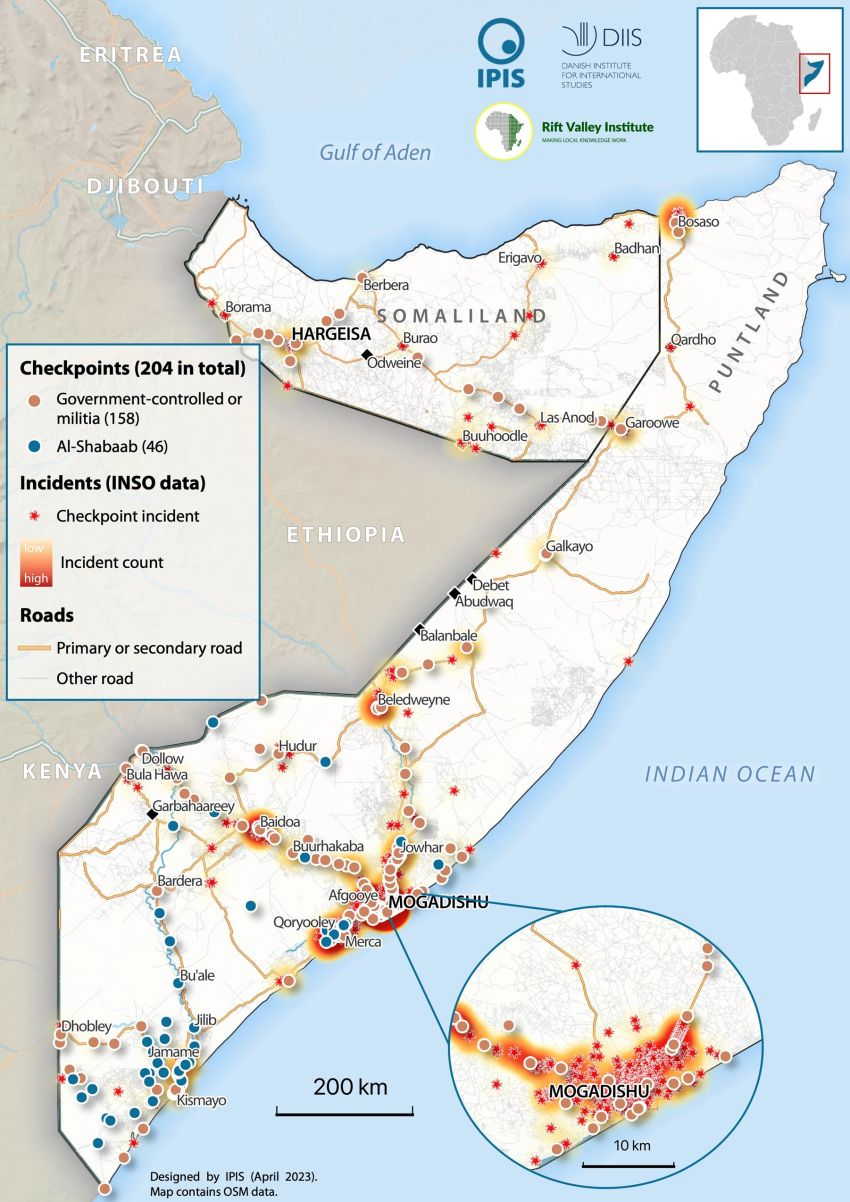
Map 4. IPIS, Distribution of violent checkpoint-related incidents (2020-2023), April 2023, url.417
- 396
EUAA, Country of Origin information Report on Somalia: Security Situation, February 2023, url, pp. 51-53
- 397
EASO, Country of Origin Information Report on Somalia: Security Situation, September 2021, url, pp. 42-44
- 398
EUAA, Country of Origin information Report on Somalia: Country Focus, May 2025, url
- 399
Schouten P., Paying the price – The political economy of checkpoints in Somalia, 2023, url, pp. 7, 10
- 400
Schouten P., Paying the price – The political economy of checkpoints in Somalia, 2023, url, pp. 7, 24, 28; see also
Abdirahman Ali, The political economy of checkpoints along the Baidoa corridor, 2023, url, p. 16 - 401
Schouten, P., Paying the price – The political economy of checkpoints in Somalia, 2023, url, pp. 11, 13, 25
- 402
Schouten, P., Telephone interview, 13 March 2025. Peer Schouten is senior researcher at the Danish Institute for international Studies (DIIS) and the International Peace Information Service (IPIS), with focus on mapping the political economy of checkpoints in conflict.
- 403
Schouten, P., Paying the price – The political economy of checkpoints in Somalia, 2023, url, pp. 14-15
- 404
Abdirahman Ali, The political economy of checkpoints along the Baidoa corridor, 2023, url, pp. 13-14; see also Jamal Mohammed, Navigating trade controls - The political economy of checkpoints along Somalia’s Garissa corridor, 2023, url, p. 15
- 405
Abdirahman Ali, The political economy of checkpoints along the Baidoa corridor, 2023, url, p. 16
- 406
Schouten, P., Paying the price – The political economy of checkpoints in Somalia, 2023, url, p. 28
- 407
Abdirahman Ali, Brokering trade routes - The political economy of checkpoints along the Baidoa corridor, 2023, url, pp. 16-17; Jamal Mohammed, Navigating trade controls - The political economy of checkpoints along Somalia’s Garissa corridor, 2023, url, p. 22
- 408
Edle A., et al., Isbaaro: checkpoints and worldmaking beyond the state, 2024, url, pp. 3-5
- 409
Schouten, P., Paying the price – The political economy of checkpoints in Somalia, 2023, url, pp. 25-26
- 410
Schouten, P., Telephone interview with EUAA, 13 March 2025
- 411
Schouten, P., Paying the price – The political economy of checkpoints in Somalia, 2023, url, p. 27
- 412
Schouten, P., Paying the price – The political economy of checkpoints in Somalia, 2023, url, p. 27
- 413
Schouten, P., Paying the price – The political economy of checkpoints in Somalia, 2023, url, p. 35
- 414
Schouten, P., Paying the price – The political economy of checkpoints in Somalia, 2023, url, pp. 35-38
- 415
Schouten, P., Paying the price – The political economy of checkpoints in Somalia, 2023, url, pp. 35-38
- 416
EUAA analysis based on ACLED data. Curated Data Files, Somalia, 21 March 2025, url, filter ‘checkpoint’
- 417
Schouten, P., Paying the price – The political economy of checkpoints in Somalia (DIIS/RVI), 2023, url, p. 36